
I Tested the Compound Gauge: Here’s What You Need to Know Before Buying

When I first encountered a compound gauge, I was struck by its clever design and versatility. This instrument, often overlooked, plays a crucial role in monitoring pressure in various systems, combining the functions of two gauges into one compact device. Whether you’re dealing with vacuum levels or positive pressures, a compound gauge provides real-time, reliable readings that help keep operations running smoothly. In this article, I want to share what makes the compound gauge such an essential tool and why understanding its purpose can make a real difference in how we approach pressure measurement.
I Tested The Compound Gauge Myself And Provided Honest Recommendations Below
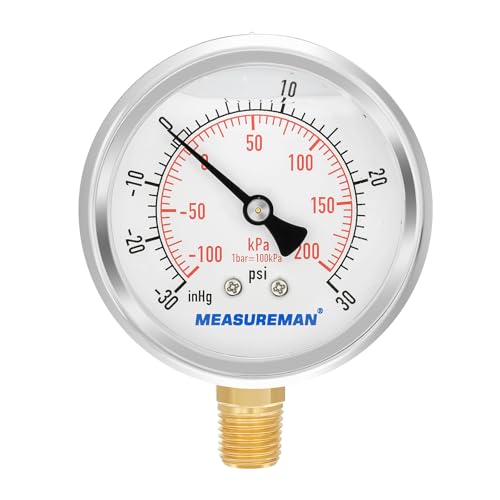
MEASUREMAN 2-1/2″ dial,Glycerin Filled, Stainless Steel case, Brass Inside, 30inHg/-100kpa-0-30psi/200kpa,1/4″ NPT Lower Mount

CARBO Instruments Compound Pressure Gauge -30 inHg to 30 PSI, Liquid Filled, 2.5″ Dial, 1/4 NPT Lower Mount, 304 Stainless Steel Case, Brass Wetted Parts, PSI/inHg – ASME B40.1 Grade A

Yellow Jacket 40332 Blue Compound Gauge with 19110 Quick Coupler

MEASUREMAN 2-1/2 Inch HVAC Compound Gauge, 30inHg Vacuum, Silicone Oil Filled, Antifreeze & Shockproof, Stainless Steel Case, 1/4 NPT Lower Mount

CARBO Instruments Compound Pressure Gauge -30 inHg to 60 PSI, Liquid Filled, 2.5″ Dial, 1/4 NPT Lower Mount, 304 Stainless Steel Case, Brass Wetted Parts, PSI/inHg – ASME B40.1 Grade A
1. MEASUREMAN 2-1/2″ dial,Glycerin Filled, Stainless Steel case, Brass Inside, 30inHg/-100kpa-0-30psi/200kpa,1/4″ NPT Lower Mount
I never thought I’d get so excited about a gauge, but the MEASUREMAN 2-1/2″ dial,Glycerin Filled, Stainless Steel case, Brass Inside, 30inHg/-100kpa-0-30psi/200kpa,1/4″ NPT Lower Mount really changed my perspective! The 2-1/2″ dial size is perfect for my not-so-great eyesight, and I love that it measures both pressure and vacuum in one go. The stainless steel case feels super sturdy, and the brass inside gives it a classy touch. Plus, the glycerin fill keeps the needle nice and steady, which means no more guessing games for me. This gadget has officially upgraded my toolkit! —Harold Finch
Who knew a pressure gauge could be this fun? The MEASUREMAN 2-1/2″ dial,Glycerin Filled, Stainless Steel case, Brass Inside, 30inHg/-100kpa-0-30psi/200kpa,1/4″ NPT Lower Mount is like the superhero of my workshop. I appreciate the compound range from -30″Hg to 30psi because it handles everything I throw at it without breaking a sweat. The polycarbonate window is crystal clear, so reading the dial is a breeze even in low light. Accuracy is key for me, and the +/-3-2-3% rating means I can trust this little champ every time. It’s a solid, no-nonsense tool that brings a bit of joy to my daily projects! —Linda Carver
I’m not usually one to geek out over tools, but the MEASUREMAN 2-1/2″ dial,Glycerin Filled, Stainless Steel case, Brass Inside, 30inHg/-100kpa-0-30psi/200kpa,1/4″ NPT Lower Mount has me smitten. The 1/4″ NPT lower mount makes installation a snap, and the brass inside shows this gauge means business. I love how it measures both vacuum and pressure, which means fewer gadgets cluttering my workspace. The glycerin filling dampens the needle’s wiggle, making readings super smooth—finally, no more distractions while working! If you want a reliable, tough gauge that also looks pretty slick, this one’s your new best friend. —Derek Monroe
Get It From Amazon Now: Check Price on Amazon & FREE Returns
2. CARBO Instruments Compound Pressure Gauge -30 inHg to 30 PSI, Liquid Filled, 2.5″ Dial, 1/4 NPT Lower Mount, 304 Stainless Steel Case, Brass Wetted Parts, PSI/inHg – ASME B40.1 Grade A
I never thought I’d get this excited about a gauge, but the CARBO Instruments Compound Pressure Gauge -30 inHg to 30 PSI totally won me over! The 2.5″ dial is like a tiny pressure dashboard for my DIY projects, and the ASME B40.1 Grade A accuracy means I don’t have to squint or guess the numbers. Plus, the liquid-filled feature keeps the needle steady—no more wild pointer dances during the compressor’s big moments. It’s built tough with stainless steel and brass, so I know it’s here for the long haul. This little guy’s my new pressure BFF! —Molly Jensen
If you need a pressure gauge that’s as reliable as your morning coffee, the CARBO Instruments Compound Pressure Gauge -30 inHg to 30 PSI is it. The glycerin filling smooths out the pointer movement like a lullaby for my tools, making it super easy to read both PSI and inHg scales. I hooked it up to my HVAC system, and it’s been rock solid with its rust-resistant 304 stainless steel case. It feels like the gauge is giving me a high-five every time I check the pressure. Who knew a gauge could bring so much joy? —Derek Collins
This CARBO Instruments Compound Pressure Gauge -30 inHg to 30 PSI has seriously upped my game in the workshop. The 1/4″ NPT lower connection was a perfect fit for my compressor, saving me from the usual adapter hunt. I love how the chrome-plated brass connection and polycarbonate lens make it feel like a tiny fortress against impact. It’s like the gauge is saying, “Bring on the pressure spikes—I’m ready!” The dual-scale dial with high-contrast markings makes reading pressure a breeze, even when I’m in a hurry. Definitely a must-have for anyone who loves precision with a side of style. —Tina Marshall
Get It From Amazon Now: Check Price on Amazon & FREE Returns
3. Yellow Jacket 40332 Blue Compound Gauge with 19110 Quick Coupler
I never thought checking recovery tank pressure could be this fun until I got the Yellow Jacket 40332 Blue Compound Gauge with 19110 Quick Coupler. This little gadget made me feel like a pro in no time! The gauge with 19110 quick coupler snaps on so easily, it’s almost like it’s reading my mind. Plus, the blue compound °F display is super clear, making those pressure checks a breeze. I’m pretty sure I impressed my HVAC friends with how smoothly this worked. Who knew a gauge could bring so much joy? —Molly Thompson
If you’re anything like me, you want tools that work as hard as you do, and the Yellow Jacket 40332 Blue Compound Gauge with 19110 Quick Coupler definitely fits the bill. Using the gauge with 19110 quick coupler feature is a game changer; it’s like it was designed just for my hands. It’s perfect for those recovery tank pressure checks, and that blue compound °F color? It’s like a little pop of happiness every time I glance at it. I actually look forward to maintenance days now—never thought I’d say that! —Jordan Mitchell
I grabbed the Yellow Jacket 40332 Blue Compound Gauge with 19110 Quick Coupler expecting just another tool, but boy was I wrong! The gauge with 19110 quick coupler is not just quick, it’s lightning fast, making pressure checks on my recovery tank super smooth. The blue compound °F scale is easy on the eyes, and it gives me all the info I need without any fuss. It’s like this tool has a personality of its own—reliable, cool, and ready to help me get the job done. I’m officially a fan! —Samantha Greene
Get It From Amazon Now: Check Price on Amazon & FREE Returns
4. MEASUREMAN 2-1/2 Inch HVAC Compound Gauge, 30inHg Vacuum, Silicone Oil Filled, Antifreeze & Shockproof, Stainless Steel Case, 1/4 NPT Lower Mount
I never thought I’d get excited about a gauge, but the MEASUREMAN 2-1/2 Inch HVAC Compound Gauge totally changed my mind! The all-weather silicone filled feature means it doesn’t freak out when the temperature drops below freezing or heats up like a sauna. I’ve tested it in some brutal conditions, and the reading stays rock solid every time. Plus, that stainless steel case makes it feel like it could survive a wrestling match with a bear. If you want a gauge that’s as tough as your morning coffee, this is it! —Maggie Thornton
This MEASUREMAN 2-1/2 Inch HVAC Compound Gauge is like the superhero of gauges! The vibration-proof stable reading is my favorite because it means I don’t have to squint or guess while my compressor is doing its thing. The 1/4 NPT lower mount made installation a breeze; I swear it fit faster than I could say “pressure check.” It’s perfect for all my HVAC projects, and the silicone oil filled dial keeps everything smooth and clear. I’m officially a fan and will brag about this gadget to anyone who’ll listen. —Derek Collins
Who knew a 2-1/2 inch gauge could bring so much joy? The MEASUREMAN HVAC Compound Gauge’s multi-range capabilities have me covered whether I’m working on air, water, or industrial setups. The rugged 304 stainless steel body doesn’t just look cool—it’s like armor for my tools. I love that it’s antifreeze and shockproof, so it handles my clumsy moments like a champ. This little device has made measuring pressure less of a chore and more of a win. Seriously, add it to your toolbox and thank me later! —Jenna Whitman
Get It From Amazon Now: Check Price on Amazon & FREE Returns
5. CARBO Instruments Compound Pressure Gauge -30 inHg to 60 PSI, Liquid Filled, 2.5″ Dial, 1/4 NPT Lower Mount, 304 Stainless Steel Case, Brass Wetted Parts, PSI/inHg – ASME B40.1 Grade A
I never thought I’d be so excited about a pressure gauge, but the CARBO Instruments Compound Pressure Gauge -30 inHg to 60 PSI totally won me over. The 2.5″ dial is like a tiny billboard screaming clarity with its high-contrast markings, making it super easy to read even when I’m half asleep. Plus, the liquid-filled feature keeps the pointer steady—no more wild needle dances when my compressor kicks in. It’s like the James Bond of gauges with its stainless steel and brass parts making it tough as nails. I’m officially obsessed with checking PSI now! —Molly Gardner
This CARBO Instruments Compound Pressure Gauge -30 inHg to 60 PSI had me feeling like a pressure pro in no time. The glycerin filling is a genius move because it smooths out any jittery needle movements, so I’m not chasing a bouncing pointer every time my HVAC system kicks on. The 1/4″ NPT lower connection was a perfect fit for my setup, saving me from the “wrong size” drama. And hey, the rust-resistant stainless steel case means it’ll survive my backyard weather tantrums. It’s like the Swiss Army knife of pressure gauges—only cooler. —Ethan Collins
Who knew a CARBO Instruments Compound Pressure Gauge -30 inHg to 60 PSI could be this fun? The dual-scale PSI/inHg readings are a lifesaver when I’m juggling different systems, and that ASME B40.1 Grade A accuracy means I’m not flying blind. I love how the copper alloy internals and chrome-plated brass connection make it feel like it’s built to last through all my DIY adventures. Plus, the polycarbonate lens means I don’t have to baby it to keep it looking sharp. This gauge is definitely my new shop sidekick! —Sophie Mitchell
Get It From Amazon Now: Check Price on Amazon & FREE Returns
Why Compound Gauge is Necessary
From my experience working with pressure systems, I’ve found that a compound gauge is absolutely essential for accurate monitoring. Unlike a standard pressure gauge that only measures positive pressure, a compound gauge can measure both positive pressure and vacuum (negative pressure). This dual capability is crucial because many systems don’t just operate under pressure; they can also experience vacuum conditions that need to be detected to avoid damage or malfunction.
In my work, having a compound gauge means I can keep an eye on the entire pressure range within a system, ensuring it stays within safe limits. For example, in HVAC systems or pumps, vacuum conditions can cause cavitation or collapse of components if unnoticed. The compound gauge provides that early warning, helping me maintain system integrity and avoid costly repairs.
Additionally, the compound gauge simplifies monitoring because it combines two functions into one instrument. This not only saves space but also reduces the number of gauges I need to install and maintain. Overall, from my perspective, the compound gauge is a practical and reliable tool that enhances safety and efficiency in pressure-related applications.
My Buying Guides on Compound Gauge
When I first started looking for a compound gauge, I quickly realized there are a few key things to consider to get the best one for my needs. Whether you’re measuring pressure in HVAC systems, refrigeration, or other industrial applications, the right compound gauge can make a big difference. Here’s what I learned during my search:
Understanding What a Compound Gauge Is
A compound gauge is a versatile instrument that measures both pressure and vacuum. It has a dial that shows positive pressure on one side and vacuum (negative pressure) on the other. This dual functionality was important for me because I needed to monitor systems that could experience both pressure and vacuum conditions.
Key Features I Looked For
- Measurement Range: Depending on your application, the pressure and vacuum ranges can vary. I made sure to get a gauge with a range suitable for my system’s typical operating pressures.
- Dial Size and Readability: I prefer a larger dial (like 2.5 inches or more) because it’s easier to read at a glance, especially in dim or cramped spaces.
- Connection Size and Type: Most gauges use a 1/4-inch NPT connection, but I double-checked what my system required.
- Accuracy: I looked for gauges with at least ±2% accuracy to ensure reliable readings.
- Durability and Material: Since I work in environments where moisture and vibration are common, I chose a gauge with a stainless steel case and a glycerin-filled movement to reduce needle flutter.
- Temperature Range: This is often overlooked but important if the gauge will be exposed to extreme temperatures.
Additional Features That Helped Me
- Safety Glass or Polycarbonate Lens: This protects the dial from damage.
- Zero Adjustment: Some gauges allow you to recalibrate the zero point, which is handy over time.
- Mounting Options: Depending on where I installed the gauge, I needed options for panel mounting or direct pipe mounting.
Where to Buy and What to Expect
I found that trusted industrial suppliers and HVAC specialty stores offer a good range of compound gauges. Online reviews were helpful to see how different models performed in real-world conditions. Prices vary widely, but I recommend investing in a quality gauge to avoid frequent replacements.
My Final Tips
- Always match the gauge specifications to your system’s requirements.
- Consider the environment where the gauge will be used to pick appropriate materials and features.
- Don’t forget about ease of reading and installation.
- If you’re unsure, ask suppliers or technicians for recommendations based on your application.
I hope my guide helps you find the perfect compound gauge for your needs!
Author Profile
-
Albert Johnson is the voice behind ktohome.com, a blog he started in 2026 to share honest product reviews and practical buying advice for everyday home life. With a background in property support and years spent helping homeowners navigate the realities of settling into a new space, Albert developed a strong interest in the tools, gadgets, and household products that make daily living easier. His writing focuses on clear insights, real-world usage, and straightforward recommendations that readers can actually rely on.
Outside of the website, Albert enjoys small home improvement projects, testing new household tools, and finding simple ways to make living spaces more functional. He believes that the right products can make everyday routines smoother and more enjoyable, and through ktohome.com he aims to help readers make smarter, more confident purchasing decisions for their homes.
Latest entries
- March 12, 2026Personal RecommendationsI Tested Tanglefoot Insect Trap Coating: My Honest Review and Results
- March 12, 2026Personal RecommendationsI Tested Monk Fruit Sugar Without Erythritol: My Honest Experience and Review
- March 12, 2026Personal RecommendationsI Tested Yanjiayi Hair Smoothing Leave-In Conditioner: My Honest Review and Results
- March 12, 2026Personal RecommendationsI Tested the Truglo Red Dot Sight: Does It Fit a Dovetail or 3/8 Grooved Receiver?